Professor Karen Malone, Swinburne University of Technology
I would like to start by acknowledging the Bunurong People of the Kulin Nation who are the Traditional Custodians of the Unceded Land I am posting from and pay my respect to Elders past, present and emerging. I celebrate the diversity of Aboriginal and First Nation peoples in Australia and from across the globe, and their ongoing cultures and connections to the lands, animals and waters of their country.
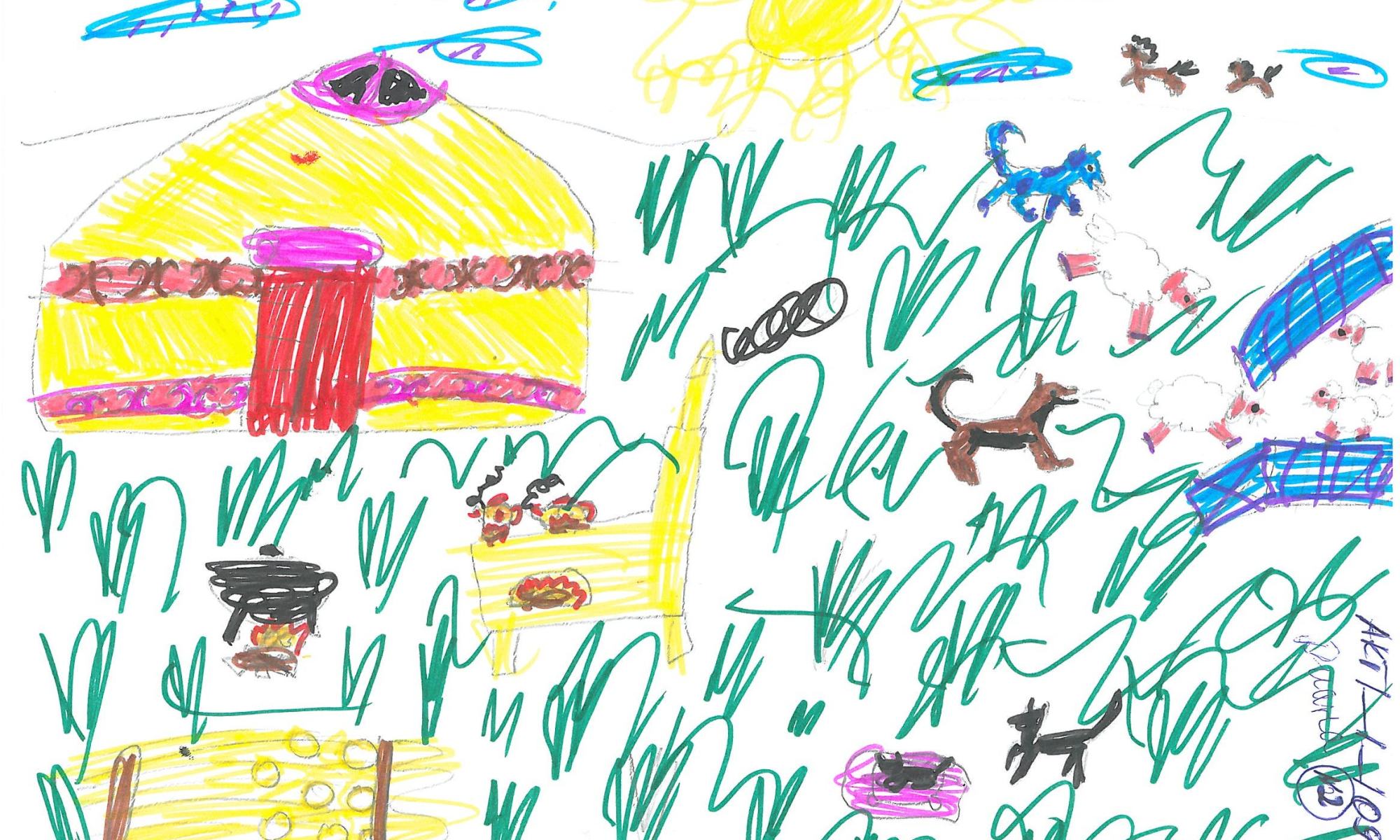
I would also the opportunity to share with you the background to the image attached to this post as way of introduction.
The image is a speculative drawing by Diana, aged 8 years, from Aktau, Kazakhstan. When I visited Diana’s school as part of the Children in the Anthropocene project I asked her and her class mates to a draw a picture of their dream future life. Diana lives in Aktau a town in the west of Kazakhstan on edge of the Caspian sea which has an abandoned nuclear power station which is causing significant radiation pollution. When she showed me her drawing she told me she would like to return to a traditional nomadic life like her ancestors. Her drawing includes a scene reminiscent of her Kazakh herders, a yurt located in a wild and abundant steppe. She explained: “I would like to live on the steppe because I want to be with animals and nature. Also, the air there is clean, and there are big and beautiful mountains. And I like to walk in the fields”. As I was leaving she thanked and said no one had ever asked her before what she wanted for her future, or for the future of the planet. I think that is where we might start ….
What kinds of worlds can educational research help us create?
This question has shaped my research journey for more than three decades. Across this time, my work has moved from children’s participation rights and child-friendly cities toward ecological, posthuman, and animist understandings of education in the Anthropocene. What has remained constant, however, is a concern for how education might respond ethically to the conditions of the world children inherit and inhabit.
We are living in a time of overlapping planetary crises: climate instability, biodiversity loss, toxicity, social inequity, war, technological acceleration and ecological uncertainty. None of these conditions are external to education. They shape children’s everyday lives, their futures, and increasingly their embodied, ecological worlds. If education has always been concerned with preparing young people to engage with the key problems of their time, then the Anthropocene demands not simply educational reform, but a philosophical reorientation.
It requires us to rethink what it means to be human, what matter matters, what counts as knowledge, how learning occurs, and how we might live well together within fragile multispecies worlds.
Growing Up in Cities and Child Friendliness: The Early Human-Centred Paradigm
My early research work emerged during the 1990s alongside the rise of the new sociology of childhood and the United Nations Convention on the Rights of the Child. Influenced by critical theory, ecofeminism, geography, and participatory research traditions, I positioned children not as passive recipients of adult decisions, but as active citizens and knowledgeable participants capable of shaping their own environments.
This work formed the basis of my involvement in UNESCO’s Growing Up in Cities project and later UNICEF’s Child Friendly Cities initiative. Across these projects, which ran from 1996-2016 I worked with children in urban communities around the world to understand how they experienced neighbourhoods, schools, public spaces and city life.
Participatory methodologies became central to this work. Children engaged as co-researchers through mapping, photography, storytelling, walking-with, drawing and documenting their everyday worlds. Educational research which at the time was quite innovative and new, especially in the context of low income nations or post-cold war communities. The research focused on participation, belonging, mobility, environmental justice, sustainability and child-friendliness.
At the centre of this work was a human-centred research paradigm grounded in children’s rights and democratic participation. The city was understood primarily as a social – cultural environment that could either support or constrain children’s wellbeing.
Yet over time, I began to question whether dominant understandings of child-friendliness and sustainability were sufficient for the emerging conditions of the Anthropocene. Across many of the sites where I worked, children’s lives were increasingly shaped by pollution, environmental degradation, climate instability and ecological uncertainty. Children were not simply living in environments. They were deeply entangled within ecological, atmospheric and more-than-human worlds.
This realisation prompted a profound ontological shift in my research.
Children in the Anthropocene: Beyond Human-Centredness
Through my Children in the Anthropocene work, which started around 2016 my research moved beyond human-centred and developmental frameworks toward ecological, posthuman and new materialist perspectives.
Posthuman and new materialist theories reject the assumption that humans exist separately from the world. Rather than viewing matter as passive or inert, these approaches understand the world as vibrant, relational and co-constituted. Humans, animals, weather systems, technologies, materials and landscapes are entangled in dynamic processes of becoming.
Thinkers such as Jane Bennett, Karen Barad, Donna Haraway and Rosi Braidotti profoundly reshaped my understanding of childhood, agency and learning. Childhood was no longer understood as an isolated human experience unfolding through universal developmental stages. Instead, childhood became something formed through relations with land, water, climate, animals, atmospheres, technologies and place.
This shift also transformed my methodologies. I moved away from relying solely on representation, themes and the human voice toward research attentive to affect, embodiment, atmospheres and multispecies encounters. Walking-with methodologies, sensory inquiry and postqualitative approaches became ways of exploring children’s ecological entanglements in everyday life.
The key shift was from seeing children in environments to understanding children as environments — deeply entangled within ecological and more-than-human worlds.
From Representation to Relational Becoming
Posthuman and new materialist relational ontologies offer powerful ways for rethinking education generally and ecological education more specifically.
Postdevelopmental and posthuman pedagogies challenge the linearity, individualism and anthropocentrism of traditional developmentalism inherited from Enlightenment thinking. Education has long been shaped by assumptions that humans are exceptional and that knowledge involves mastering an external world.
Yet earlier cosmologies understood the world very differently.
Pre-Christian and Indigenous cosmologies positioned humans within an animistic cosmos alive with spirit, force and relational agency. Matter was not inert; it was vibrant, responsive and ethical. Humans lived in reciprocal and symbiotic relations with all living things.
The rise of Christianity and Enlightenment rationalism fundamentally altered this worldview. The Cartesian split separated mind from body, human from nature, subject from object. Matter became passive and dead, while humans were positioned as rational, moral and transcendent beings capable of mastering nature.
Western education systems mirrored this metaphysical divide. Learning became associated with cognition, control, categorisation and representation. The learner was imagined as separate from the world.
These assumptions continue to shape dominant educational models today.
Take cognitive load theory, for example, now highly influential within cognitive neuroscience approaches to education. Such models being introduced around the world including here in Australia argue that teaching should minimise “extraneous” cognitive load in order to optimise efficient information processing and streamlined learning. These approaches occupy a somewhat paradoxical position in educational theory as they remain deeply rooted in Enlightenment-era humanism and cognitivism.
Therefore, what cognitive science may classify as “extraneous,” posthuman pedagogies might recognise as generative, affective and emergent. This creates significant tension, even conflict, with the design of rich, deep, embodied, innovative learning environments, especially those inspired by Reggio Emilia, Posthumanist, New materialist pedagogies and Indigenous approaches. What cognitive load theory or neuroscience sees as ‘extraneous’ posthumanist education may see as creative, generative or inviting emergence.
Posthumanists would argue learning is seldom linear or efficient; it’s complex, affective, and co-constituted with environments. It is the experiential, being-in the real world that these encounters open up those possibilities.
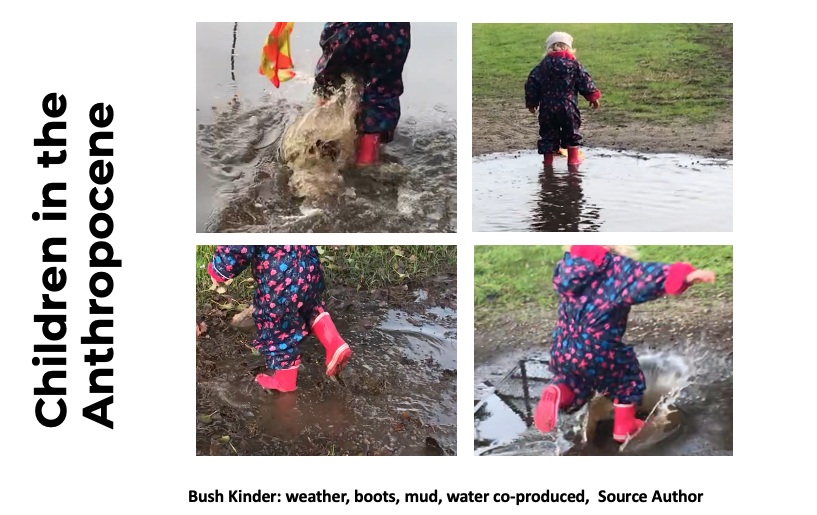
In one encounter, with a group of kindergartners on a Bush Kinder day we find ourselves in a muddy puddle left during a rainstorm. Rather than walking around the puddle we became engrossed in the tactile, rhythmic qualities of mud, water, and splashing. The enticement of the material encounters is not separate from the weather, boots, mud, water; they are co-produced. This moment of entangled play exemplifies what Manning (2016) calls ‘affective attunement’ – these openings for experiencing weather and rain, floods and droughts teach us how water is central to our survival.
Learning from a posthumanist perspective is not internal information processing.
Learning is always emergent, affective, and co-constituted with land, creatures, technologies, weather, and time and children are not incomplete beings waiting to process ‘information’, to be filled up but relational actors within complex socio-ecological – material assemblages.
From a posthuman perspective learning unfolds through embodied encounters with weather, materials, creatures, technologies and places. It is experiential, affective and ecological. Knowledge is not simply processed internally by isolated minds but emerges relationally through participation in the world.
Posthumanism doesn’t just decentre the human; it proposes new modes of becoming-with and being-in the world as not only human . This shift challenges the notion educating lies in the educators capacity to support children to represent, categorise, or master the world.
Indigenous Philosophies and Animist Relationality
My collaborations with Indigenous and First Nations communities in my early days also profoundly deepened and challenged my research.
Indigenous philosophies do not begin from the separation of humans and nature that underpins much Western thought. Instead, they foreground relational ontologies in which humans exist within reciprocal relations with land, water, ancestors, spirits, animals and ecological worlds. This is a key foundation to my reimagining of education, especially when I could observe schools in places like Bolivia operating in pluriverse curriculum contexts. That is, teaching western science alongside of cosmological understandings rich in Pachamama. Pachamama being the revered Mother Earth in Andean (Quechua/Aymara) cosmology which embodied deep connections and knowledge of the earth, nature, sustenance. The science of survival and human and non-human flourishing. Animist beliefs held by children from birth threaded in their education.
Animism isnt new to education. Developmental theorists such as Piaget for example framed children’s early cognition as starting with animism and moving to egocentricsm and then anthropocentricsm. Piaget argued in his 1929 book The Conceptions of Childhood that “it is an undoubted fact that a child’s thought starts with the idea of a universal life” and animism “is a primitive principle” and it is only by “a series of progressive differentiations that inert matter comes to be distinguished from that which is living” (p. 230). In a book I am writing at the moment entitled Children Sensing Ecologically, I provide a cartography of research on children and anthropocentricism and argue the case that children are not innately born anthropocentric as Piaget agrees but rather than call it an error of primitive reasoning (aligned with savages) that needs to be corrected I see it as a natural animist state which should be nurtured rather than replaced with western reasoning. And that Indigenous knowledge systems can show us how because unlike western educationists they have no need to unlearn anthropocentrism, as they have maintained animist, non-anthropocentric traditions.
These engagements reshaped my thinking about what sustainability, education and childhood could be if we nurtured animism and emphasised kinship, reciprocity, coexistence and collective responsibility.
Importantly, Indigenous philosophies have helped expose anthropocentrism not as an inevitable human condition, but as a historical legacy of Western Enlightenment thought.
And increasingly I want to argue children’s ecological animism not as deficit, but as a relational capacity that should be nurtured rather than erased.
Children, especially very young children (my recent research is with toddlers aged 1-3 years) experience the world as alive, responsive and communicative. They form deep affective relations with trees, puddles, weather, animals and places. Indigenous cosmologies remind us that such relational understandings are not irrational remnants of premodern thought but living onto-ethical traditions grounded in responsibility and reciprocity.
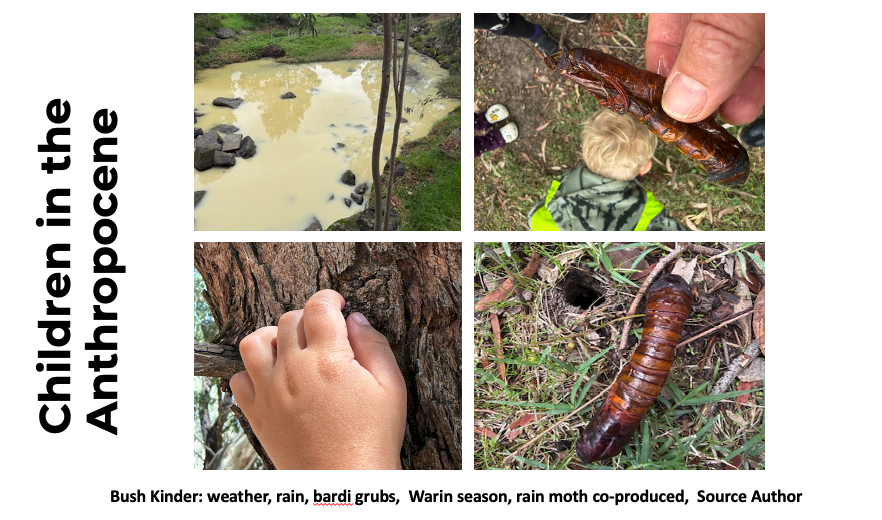
It is Autumn or Warin (wombat and Moth) season in Naarm (Melbourne) Australia. As we walk into the parklands the children and I notice the creek is flowing quickly, the water is high on the bank and looks contaminated with something, probably washed in from a building site. What is that? The children ask? As we walk towards the bush site many questions are raised by the children: what does this pollution mean for fish in the creek or the frogs, can birds still drink the water? Would it harm them. As we settle in for our day and children disperse to explore this familiar area, a couple of them call out for us to come see something. What they have found on the ground looks to be exoskeleton casing – but what animal is this? We have often found cicada exoskeletons but this was different shape and colour. They ask where did it come from? What was it? Where is it now? And there wasnt just one as we looked around we found lots on these empty casings on ground. Maybe they came from the Eucalyptus trees, normally when we see caterpillar casings they are on the tree but the children didn’t see any in the trees just on the ground. Then one child calls us over to see one casing which was sticking out of hole. When we pulled the casing out we could see it was the perfect size and one child who out their finger in told us it was warm and felty inside. What was this?
At the same time, it is crucial not to collapse Indigenous knowledges into posthuman theory. As Indigenous scholar Zoe Todd warns, Western scholarship risks appropriating Indigenous relational ontologies without acknowledging their specific histories, responsibilities and grounded practices. Ethical engagement requires place-responsive respect and accountability.
Ethical Educational Futures in the Anthropocene
The Anthropocene demands new ethical responses.
Posthuman and new materialist thinking asks us to move:
- from mastery to coexistence
- from extraction to reciprocity
- from certainty to attunement
- from human-centredness to shared planetary responsibility
Matter is alive, responsive and relational. Ethics emerges not as abstract moral instruction but through encounters with human and more-than-human worlds.
Education therefore becomes a practice of learning how to live well together within ecological precarity.
Rather than preparing children for some distant abstract future, education becomes an ethical practice of becoming-with. Learning unfolds through care, creativity, imagination and relational responsibility. Children are recognised not as future citizens in waiting, but as participants in collaborative world-making.
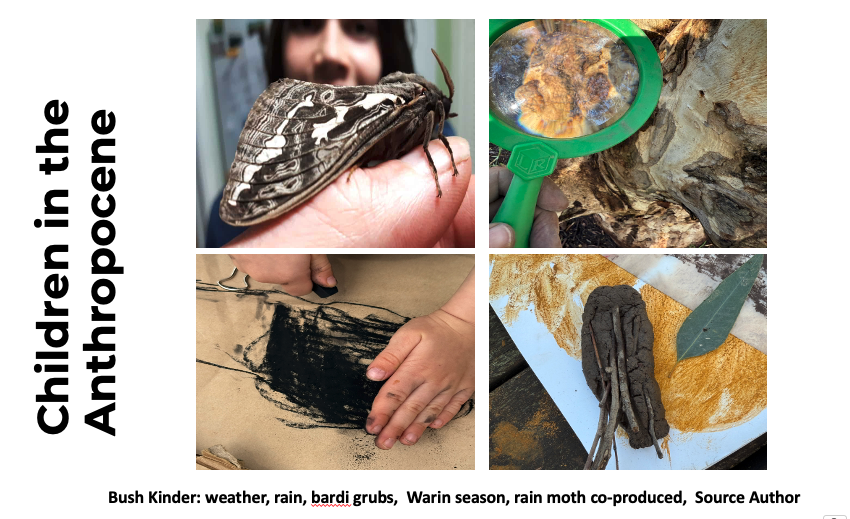
One of my teacher education students photographs the strange casing we have found and quickly discovers it belongs to a Rain moth — known by many Aboriginal communities as the bardi grub. For 7 years the larvae live underground in dark tunnels beneath eucalyptus trees, feeding quietly on roots and waiting for the heavy rains of Autumn. After as long as seven years, they emerge, breaking open their outer skins before transforming into moths that will live for only a single day. In that brief life they mate, lay thousands of eggs, and disappear again into the cycles of earth and weather. The discovery changes the rhythm of our day. The children begin to move differently through the bush site, attuning to rain, puddles, mud, tree roots and the swollen creek nearby. Some imagine what it might feel like to emerge after years underground, squeezing from a casing into sunlight, wind and open air. Others flap their arms like moth wings, run through the trees, draw the delicate casings with charcoal, or shape chrysalis forms from mud and sticks. Magnifying glasses search holes in the ground and eucalyptus branches overhead in the hope of spotting a newly emerged moth. What began as a chance encounter becomes something much larger — a pedagogical invitation into other worlds and temporalities. The children do not simply learn about the moth; they momentarily become-with it, imagining underground lives, seasonal rhythms, rain, vulnerability and transformation. In these encounters, education shifts away from mastering knowledge toward attunement, relationality – shared ethical worlds.
This ethical reorientation is especially urgent in the context of climate crisis and ecological loss. Children growing up in damaged worlds need pedagogies that help them engage complexity through attentiveness, responsiveness and rather than denial, distraction or technocratic control. This aligns with Anna Tsing’s idea of ‘collaborative survival’, living and learning in the ruins of the Anthropocene not through mastery, but through shared experimentation, imagination, creativity and care
Eco-Democracy and Educational Futures
This work now informs our emerging funded Eco-Democracy and Teacher Education research project across Sweden and Australia. Eco-democracy is an ethical and pedagogical commitment to ecological justice, collective survival and multispecies coexistence. It asks what democracy might become if more-than-human worlds were recognised as part of our ethical and political communities.
Our research explores how ecological practices can be embedded within teacher education, early childhood settings and primary schools through pedagogies grounded in ecological care, justice and responsibility.
We are interested in how educators and children might collectively learn to attend, respond and live responsibly within entangled ecological worlds. The goal is not education for environmental management or mastery but for relational coexistence. Eco-democracy, supports an integration of ecological concerns within democratic principles, in order that democracy is reconstituted to include the rights, voices, and agencies of the more-than-human.
Imagining Otherwise
Ultimately, the question remains: What kinds of worlds can educational research help us create?
I believe educational research should allow us to imagine otherwise. What could this otherwise be?
To imagine “doing theory” differently — refusing the idea that theory lives only in texts, policies or adult academic discourse. Instead, theory emerges in lived encounters: in mud sticking to children’s boots, in polluted creeks, in the silence where birdsong once existed.
Theory as lived encounter.
To imagine a pedagogical reorientation where education no longer positions children outside the world, but deeply implicated within it.
Pedagogy as ethical coexistence.
To imagine curriculum not as pre-prepared lessons delivered efficiently toward measurable outcomes, but as practices of relational restoration and regeneration — invitations to attune, respond and become-with the Earth.
Curriculum as relational regeneration.
And finally, to imagine education creating time to slow down, pause, notice, listen and wonder.
Learning as attentiveness and response.
As researchers and educators in the Anthropocene, perhaps our task is not to prepare children to dominate the world or escape it, but to help them dwell within it responsively, tenderly and collectively.
As a response to researching how children are in the Anthropocene, I have had opportunities to reimagine education through seeing a variety of different global education systems, and while many are focused on education as preparation for life, often grounded in elusive altruistic purposes, others see the opportunity to imagine education as otherwise, to ask what does it mean to flourish on this planet, in all its messy, fragile, beautiful chaos. As a researcher and educator working within the convergence of ancestral and contemporary philosophical, theoretical and ontological approaches, I am considering what would a responsive, ethical reorientation of educational practice, one that embraces complexity, more-than-human relationality, and refuses the universalising abstractions of modernity, look like?
That, for me, is the ethical and philosophical work fro educators and researchers for imagining otherwise.
Acknowledgement
The author would to acknowledge and thank Mid-Sweden University, Sweden for the invitation to provide the presentation from which this post has been summarised. The seminar was a celebration of my recent engagement as a Visiting Professor at Mid-Sweden University including funding to support an Australia-Sweden Eco-democracy in Education research project.

