Author Professor Karen Malone
Introduction
Many would argue we reside in a disenchanted world, stories of disasters, wars, ecological degradation weigh heavily on many. None more so than children and young people who have across the world expressed their shared despair and grief at the state of the planet. They feel this pain and anxiety because, as compassionate entities deeply interconnected with the Earth, they care. Children’s pain about the future is a ‘moral injury’, a sign their conscience is alive. To be enchanted though is to be held by surprise encounters of enchantment and to journey on with them, to give them time to play, to resonate in our bodies and in our knowing. In this paper I consider how we might foster children’s love, wonder, enchantment and joy in order that we not to lose sight of the natural world in all its magnificence and wonder, its immediacy and sensorial impact and potential for learning. Through current and historical research on children’s experiences of the environment in this presentation I will consider how education might support a reawakening of our spiritual Earthly relations, in order as educators and children we can honour and express our deepest emotions thereby healing ourselves and the planet.
I start with a simple question:
If we asked a child here today how they felt about the climate crisis—what might they say?
We already know. The short video shows Elka aged 4 years old, speaking into her IPAD sending, me the researcher, a clear message:
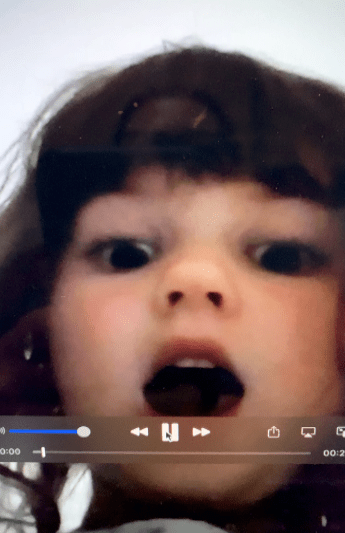
“We need to look after our planet or otherwise, otherwise it will die.
Like koalas, animals, us. Us we will die. Animals will die. Everyone will die.
I know everything is dying. I know every plant will die”.
These are not abstract fears. They are the early signs of what I refer to in this post as moral injury—evidence that children’s conscience is alive, awake, and attuned to Earth.
The burden children carry
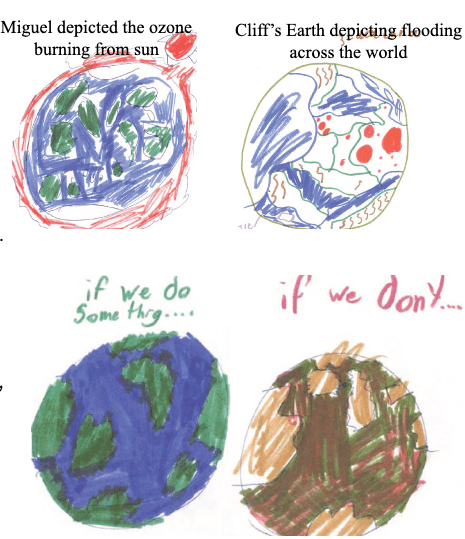
Across the world, children and young people are articulating an emotional burden that should trouble us deeply. This fear of the environment crisis is not new – and studies have abound for decades around understanding how children feel about the environment. Connell and Hutchinson in Australia in 1997 & 1999, Barraza also in 1999, Hick & Holder—all show a pattern: children express fear, sadness, cynicism, powerlessness, and grief. Children in Barazzas study depicting drawings of Earthly pollution, global warming, loss of species, lack of water, and deforestation. Strife’s study in Denver found over 80% of children worried about environmental destruction, global warming, air pollution and the way humans were killing animals, the project highlighted children’s sense of pessimism, anger, helplessness, and frustration.
“I feel sad because the animals are going to die. (Jennifer, age 10).
Something is going to happen in the world, and everything is going to get destroyed. (Lucia, age 10).
I had dreams of people crawling out of these smoke filled environments coughing, and that really scared me…(Riley, age 10)
I know that I am a little too young to help right now, so I feel helpless not being able to do anything. (Cliff, aged 10)” (Strife, 2012: 43)
When asked to draw the Earth in a 100 years’ time these concerns were further exacerbated, with drawings depicting doom and gloom; the world ending; animals dying.
Strife theorised her study using David Sobel’s (1993) interpretation of ‘ecophobia’. Sobel defines in Beyond Ecophobia it is “a helpless sense of dread about the future” and argued ecophobia was a response by children who felt overwhelmed and powerlessness and as a consequence were at risk of becoming apathetic (Sobel, 1999, Strife 2012). “What really happens when we lay the weight of the world’s environmental problems on 8- and 9-year-olds, already haunted with too many concerns. . . . ?” he asked (Sobel 1999, p. 1).
Strife argued children were not developmentally or emotionally able to cope with doom and gloom education and it was contributing to children’s feelings of environmental concern, worry and sense of helplessness. Strife and Sobel argued presenting children with global or earth-based knowledges could induce fear and apathy, and environmental education should be on science learning and environmental actions at the local-level.
Much current environmental and climate education is still influenced by this ecophobia thesis, young people finding local solutions to environmental issues as the catalyst for hope.
By far the largest and most recent study on young people’s concerns about the environment is Hickman et al.’s 2021 global survey of 10,000 young people from ten countries, Australia, Brazil, Britain, Finland, France, India, Nigeria, Philippines, UK, USA which makes the current situation brutally clear:
75% say the future is frightening.
50% believe humanity is doomed.
45% say climate anxiety affects sleep, eating, daily functioning.
And most devastatingly: Children feel betrayed by adults and governments.
They do not feel protected. They do not feel heard. This is not a phobia. Children are not irrational. They are not overly emotional or underdeveloped. They are not too young to understand. They understand precisely. They feel because they care.
Moral injury: children’s conscience is alive
Hickman uses the term moral injury, a concept from trauma studies. Moral injury occurs when:
- One witnesses harm
- Recognises it as wrong
- Yet is powerless to stop it
- And sees those with power doing nothing
A survey of child psychiatrists in England by Royal College of Psychiatrists found that 57.3% responded reported seeing children and young people distressed about the climate and environment – describing it as eco-distress of eco-anxiety. In 2025 a UK based NGO claimed children are the most vulnerable to climate-change impacts on mental health including “anticipatory anxiety” about future climate threats.
Children and young people feel anxiety is because they care (Hickman et. al 2021) Hickman et. la argue what children feel is a moral, ethical position not a psychological one. Climate inaction, Hickman writes, transgresses children’s moral beliefs about care, compassion, and ecological belonging.
“Moral injury … is a sign that one’s conscience is alive.” —Hickman et al. (2021).
For children, “it inflicts considerable hurt and wounding when they see adults including governments transgressing fundamental moral beliefs about care, compassion, planetary health, and ecological belonging” (Hickman et. al 2021, 871).
Drawing from their study Hickman et. al. (2021) argues it is paramount not to deny children’s suffering or their pleas for adults to take their future seriously as insignificant or trivial. As Joanna Macy (1983) reveals denial (especially by adult and people in powerful roles in society) is dangerous:
The conspiracy of silence concerning our deepest feelings about the future of our species, the degree of numbing, isolation a burnout and cognitive confusion that result from it – all converse to produce a sense of futility. Each act of denial, conscious and unconscious is an addiction of our powers to respond (p.10).
To feel is essential for our survival, having those feelings validated is fundamental. Repressing or hiding our fears requires tremendous energy, draws on our vitality and dulls our minds and spirit. By hiding behind the anthropocentric illusion, when we separate ourselves from the Earth, from other beings. This means we become desensitised to their suffering, we lose care and compassion (Macy, 1983).
Hickman et. al (2021) advises educators if children ask hard questions about the future or their worries then we can respond by validating those feelings and saying they should feel proud: “Because feeling anxiety or worry is about caring for the planet”. Puig de la Bellacasa (2017) describes care as flourishing liveability; as a “labour of love”; “compelling us to think with, and for, what we care about” (2017, 78). To be concerned, with an intention to care for others, is to be touched by possibilities and to embrace shared vulnerabilities.
Children feel the climate crisis not only in their minds, but in their bodies—
what I describe elsewhere as embodied wisdom: their intuitive, sensorial, affective connection to Earth, their kinship with animals, rivers, trees, fungi, mountains.
This is not pathology.
This is not a mental health disorder.
This is an ethical a caring response.
A sign of ecological conscience.
Why current educational responses fall short
For twenty years, education systems have responded by saying:
“Teach children local actions.”
“Plant trees.”
“Get them into nature.”
“Help them fix the problem.”
And psychologists say:
“Reassure them.”
“Tell them it will be ok.”
“Validate feelings, then move on, distract them.”
Or even worse – “If they are showing signs of depression or anxiety give them medication”
These may seem like comforting gestures—but they are inadequate and they blame the child, you are deficit something is wrong with you, you have a problem and needs to be dealt with by doing something to you. In other words, we want you to be ‘numb’ to these ethical caring responses.
Hickman drawing on her research writes:
Eco-anxiety is not cured by eco-action. The problem isn’t inside children.
The problem is the inaction of adults and governments. Asking children to fix the climate crisis is another form of moral injury. We must not hand children responsibility, or burden them with what they need to do to fix something they did not cause.
Disenchantment and turning away
We live in what many describe including Jane Bennet as a disenchanted world. Bennett (2001) when responding to the image of a disenchanted modernity asks not if this is real but, “rather, whether the very characterization of the world as disenchanted ignores and then discourages affective attachment to that world” (p. 3).
Ecological devastation, economic inequality, war, species extinction— children see it. They feel it. They absorb the stories into their bodies. And the dominant Western response is denial or turning away.
Joanna Macy warns that denial produces numbness, burnout, and futility. “Each act of denial is an abdication of our powers to respond” Macy (1983). Children recognise this turning away. They see it as a moral failure. And yet – Macy also tells us that pain is not something to cure; or to fix it is a sign of our/their profound interconnectedness with Earth.
By collectively, paying attention to other-than-human forces, Bennett argues we can create the capacity to dream, to imagine and to be attached to this world. She ponders how can we find a compelling means to support humans to acknowledge that our individual fate is determined not by humans, or what we do but by the nature of how we imagine our co-existence with all Earth dwellers. This sense of a shared fate, she argues, could entice us to consider new questions about how we can co-exist with, and through deeper relations with the other-than-human world. Affective imaginaries are central here in our thinking for an education that supports children’s opportunities to speculate visions of a ‘flourishing life on Earth’. The role of educators is to foster children’s imaginaries.
Rethinking children’s responses through ecological and Indigenous lenses
When we move away from psychology and pathology, and towards ecology, posthumanism, ecofeminism, Indigenous knowledges, something becomes clearer:
Children are not anthropocentric by nature.
From our research with Indigenous and non-Indigenous toddlers Sara Jan Moore and I argued: Children see themselves as nature. As animal. As part of the Earth’s body. — (Malone and Moore, 2019)
From Bolivia Yesonia, age 12 tells me: “We live and eat from the land. Pachamama is our mother.”
Children’s fears come not from seeing nature as threatening, but from seeing nature being harmed. They are grieving the loss. Every time they hear another bird species is lost, the koala trees are cut down, the ice is melting. Their grief is relational.
Children are not afraid because nature is dangerous; they are afraid because they are entangled with a living world they love. The lack of love by other is dangerous. Without modes of enchantment, children might not have the inspiration to speculate a future where humans respond generously to shared humans and other-than-human relations. Bennette argues “These enchantments are already in and around us” (Bennett, 2001, p. 174). As educators our role is to recognise and nurture their entangled lives.
Their worry is kinship-based. Their anxiety is ecological, not psychological. Indigenous teachings tell us we are always in relation to ancestors, to mountains, to waters, to future generations. Whakapapa in Aotearoa reminds us: “Every being—past, present, and future—is kin.” Children naturally think like this. Education often teaches them otherwise.
I have identified three educational pathways to respond to moral injury: non-anthropocentrism/ animism, intergenerational thinking, enchantment
1. Nurturing non-anthropocentrism/animism
Children need to remain connected to the truth they intuitively know. Knowledge they are born with. Humans are not separate from nature. We are extensions of Earth’s body.
Developmental theorists such as Piaget (1929, 1952) framed children’s early cognition as starting with animism and moving to egocentric and anthropocentric, often viewed as going through stages of projection and introjection in conjunction with language acquisition. Piaget acknowledges in his early research “it is an undoubted fact that child thoughts start with the idea of a universal life” and animism “is a primitive principle” and it is only by “a series of progressive differentiations that inert matter comes to be distinguished from that which is living” (p. 230). For decades, developmental psychologists especially those following Jean Piaget’s (1952) legacy have claimed increasing children’s ‘developed’ reasoning (in contrast to primitive reasoning) about the natural world entails supporting education to enhance an anthropocentric stance. Piaget argues unlike ‘savages’ who discover animism through the discovery of the existence of thought, for children “it is ignorance of the physic which makes them attribute life to things and it is the realisation of the fact of a thinking subject which leads them to abandon animism” (p. 239) and adopt anthropocentricism. Recent research evidence by myself and host of others (Ross et al., 2003, Herrmann et al., 2010, Marshall & Brenneman 2016, Malone 2018; Malone & Moore 2019, Merewether, 2020) encourages us to consider otherwise.
Children, especially young children and those supported to deeply know environments including Indigenous contexts, are not by default seeking anthropocentricism in their thinking. Instead, extended research encourages a reframing of these claims and proposes all children are innately born knowing and expressing deep relations with the Earth. It is western thinking that seeks devalue a child’s deep emotional connection to living and non-living entities.
Our task as educators is to protect this animist, non-anthropocentric wisdom, not override it with human centered thinking and Western dualisms. This means learning with animals as companions, plants as teachers, rivers as kin, mountains as ancestors, fungi as collaborators. As Malone & Corcoran (2024) write in our chapter “Fostering Children’s Embodied Wisdom” in the handbook of ecological civilisations: “To love the Earth is to love yourself—we are connected.”
Non-anthropocentric education by nurturing animism helps children understand
their fear is not irrational—
it is empathy.
It is care.
It is ethical attunement
It is embodied wisdom
2. Intergenerational thinking
Children’s climate grief is oriented toward the future. They think in long arcs. A child in Hickmans study explained: “When I die, my grandson will have to live through the end of the world.” Children imagine beyond their own lifetimes. This intergenerational ethics is intuitive. Capitalism dulls intergenerational thinking, the here and now the present, the need to prosper mask it. Ehrlich calls it foresight intelligence acting now for future generations, even when benefits will not be felt in our lifetime. Indigenous traditions have done this for millennia.
Māori whakapapa. Australian Aboriginal kinship with Country. Andean reciprocity with Pachamama. Children instinctively understand this. Education must honour it.
3. Hope and healing through wonder and enchantment
Leslie Head reminds us:
Hope is not optimism.
Hope is practice.
Hope is a way of being.
Jane Bennett writes: “Without modes of enchantment we may not have the energy to act.”
Rachel Carson said: “It is not half so important to know as to feel.” Embodied encounters— the smell of wet soil, the quiet of snow on mountains, the pulse of ocean in a shell— become the fertile soil for care, empathy, ethics.
Maggie Maclure writes: “Wonder is relational. It is not clear where it originates and to whom it belongs. It seems to be ‘out there’ emanating from a particular object, image, or fragments of text; but it is also ‘in’ the person that is affected. A passion: the capacity to affect and to be affected” (Maclure 2013, p. 229).
In my own work, I have witnessed children expressing wonder, awe, enchantment even in the most environmentally devastated places and imagining speculative fictions of world that could be otherwise.
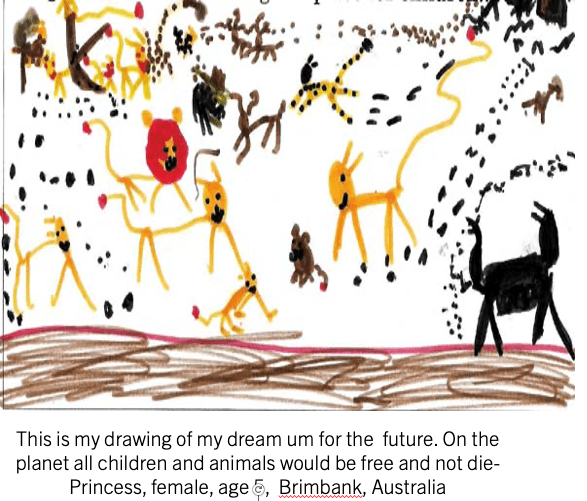
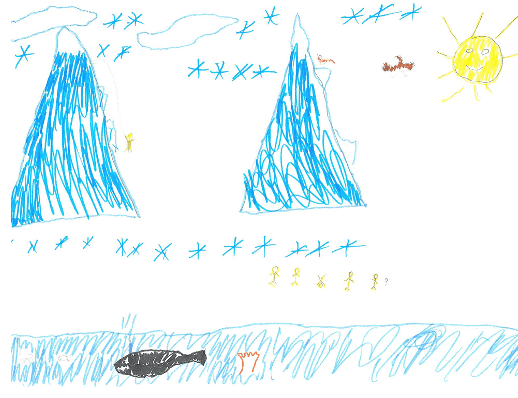
Young children in Melbourne drawing worlds where animals live free.
Wonder and Enchantment do not deny grief. They hold grief. They transform grief into desire for protection, for reciprocity, for deep relational ethics and care. Wonder is to be affected. Enchantment is to seek healing. Education located only in abstraction teaches us not to trust our wonder, our intuition, our care, our enchantment, our connection.
What children are asking of us?
Children are asking adults for three things:
Tell us the truth.
Do not deny the crisis.
Feel with us.
Do not dismiss our grief.
Act.
Do not leave the burden to us.
Education and educators need to:
- recognise and validate moral injury
- honour animist embodied wisdom
- nurture ecological belonging
- nourish intergenerational responsibility
- not deny grief but instead cultivate hope through wonder, awe, gratitude
and above all educators need to foster animist thinking and refuse the dominance of anthropocentrism
Climate anxiety is not a mental illness. It is love. It is ethical pain. It is the body saying: “I am part of this Earth, and I feel what is happening to it.”
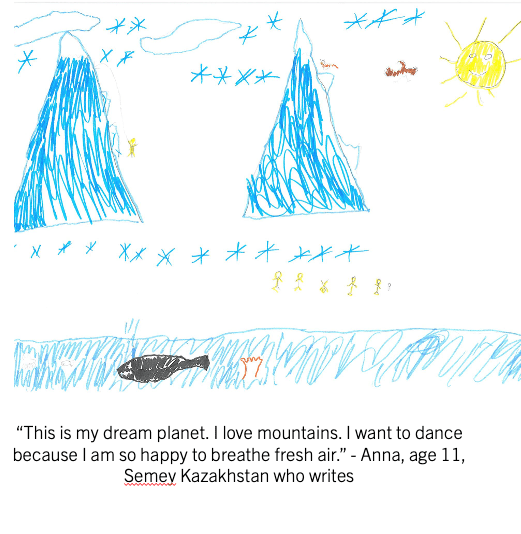
Let me leave you with the words of Anna, age 11, Semey Kazakhstan a city where 450 nuclear bombs were detonated by the Soviet union during the Cold War who writes: “This is my dream planet. I love mountains. I want to dance because I am so happy to breathe fresh air.”
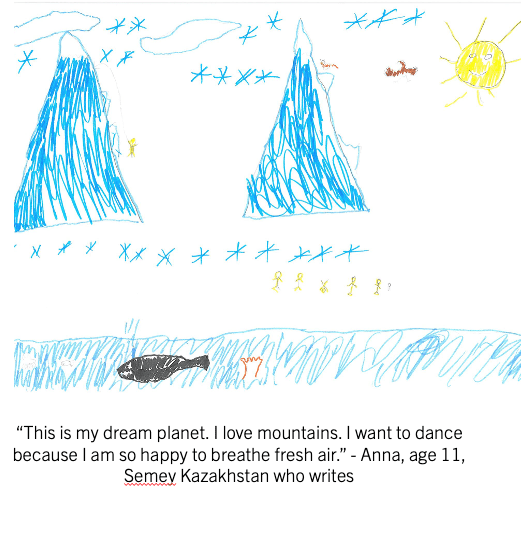
And with the wisdom of George Monbiot: “If you feel at odds with the world … it may be because you have retained the human values you were supposed to discard.”
Children have not discarded these values.
Their conscience is alive.
Our role as educators is to ensure it stays alive.
A final word from 4-year old Elka …
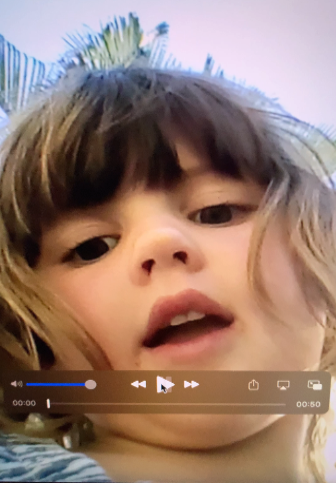
“Hi its me Elke – Hi again. Umm..
This shouldn’t be right.
I shoudnt be talking to you about it..
But um..
Did you know that we’re actually killing the planet – you know that?
Dont you?
We are killing the planet.
We’re putting rubbish on the planet.
Yeah we are. We are, yeah we are so…
I don’t know what we can do but blah blah bye”.
References
Hickman, C. Marks, E., Pihkala, P., Clayton, S. Lewandows, R. E., Mayall, E., Wray, B., Mellor, C., and van Susteren, L. (2021). Climate anxiety in children and young people and their beliefs about government responses to climate change: a global survey, Lancet Planet Health, 5; 863-873.
Macy, J. (2022). Active Hope: How to Face Crisis with Resilience and Creative Power, New World Library.
Malone K (2024) Indigenous children’s speculative future imaginaries of place, weathering and ruination. In: Bishop K, Dimoulias K (eds) The Routledge Handbook of the Built Environments of Diverse Childhoods, Routledge.
Malone, K. and Young, T. (2023) Retheorising Environmental Sustainability Education for the Anthropocene Educational Philosophy and Theory Journal, 55 (11),1200-1204.
Malone, K., Logan, M., Siegel, L., Regalado, J., & Wade-Leeuwen, B. (2020). Shimmering with Deborah Rose: Posthuman theory-making with feminist ecophilosophers and social ecologists. Australian Journal of Environmental Education, 36 (2), 129–145
Malone, K. and Moore, S.J., (2019). Sensing Ecologically through Kin and Stones, International Journal of Early Childhood Environmental Education, 7(1), p. 8-25
This paper was presented at the Philosophy of Education Society of Australasia (PESA) in December 2025.
Acknowledgement I begin today by acknowledging the Traditional Custodians of the lands on which we gather, and paying my respect to Elders, past, present, and emerging. I honour the deep Indigenous wisdoms that continue to teach us how to listen—to land, to water, to sky, and to one another.
Funding Acknowledgement: The videos of Elke come from the Department of Education Queensland HORIZON grant on Mapping Nature Play (2019-2023) with Amy Cutter Mackenzie, Karen Malone, Linda Knight and Lexi Lascik Find out more from: www.childhoodnatureplay.com
 Environmental Sustainability Education in the Anthropocene Collective