By Professor Karen Malone
Introduction
Ursula Le Guin writes “It’s up to authors to spark the imagination of their readers and to help them envision alternatives to how we live.” She reminds us our writing is both warning and promise and it is never innocent. When we write, we have a responsibility to envision possibilities, and when we touch – in that touching we change both ourselves and our worlds. But what happens when the “I”, the protagonists in our stories of change and transformation when our autoethnography is no longer only human?
Critical autoethnography has long offered us a mode for troubling, fixed boundaries: between researcher and subject, self and system, personal narrative and political critique. It is a genre that resists objectivity and embraces entanglement. Yet, in a time of planetary unravelling — of melting glacier and mass extinction, I ask: can autoethnography also be more-than-human? Speculative interspecies autoethnography is one such simple way I am practicing how to write multispecies futures by unsettling the sovereign human subject by inviting other beings — animals, rivers, glaciers, atmospheres, – into the autoethnographic “I.”
This is not only a stylistic flourish but a theoretical shift. Mazzei and Jackson (2017) remind us, “voice” is not singular and not limited to humans. Voice is emergent, material, part of an agentic assemblage. Bennett’s (2010) notion of vibrant matter and Barad’s (2007) intra-action highlight that humans are always already entangled, and matter speaks back. Speculative interspecies autoethnography is a method of speaking-with and back to the future. Let me start by reading a short piece from my recent book Wilding Ecologies, Walking-with Glacier (Malone et. al 2024) where the glacier and I share conversation.
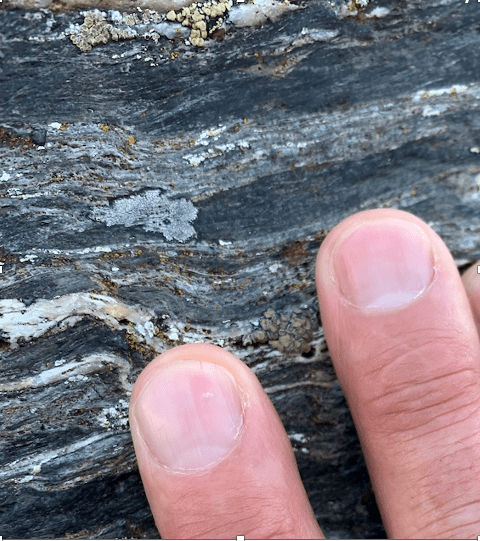
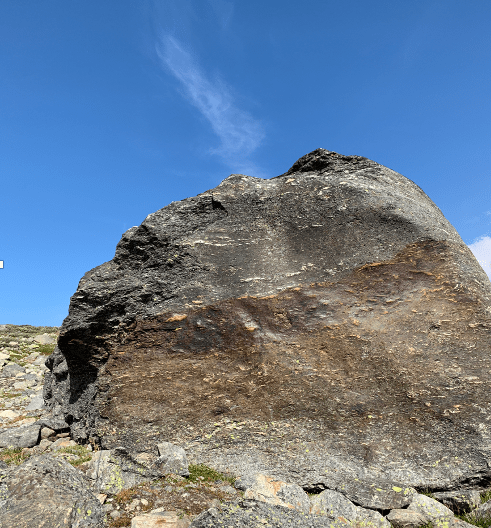
“At one juncture, as we walked through this tampered landscape, we paused to be present with a large piece of bedrock. The place spoke of its tremendous power and longevity It spoke to us through a connection to an Earth under constant construction, constant change, constant evolution. Being present, we felt layers in the rock as we ran our fingers across its sensuous ridges. We glimpsed into deep time, billions of years traversed under the sweep of our fingers. Created by your Glacier.
Littering
As I flow over the land, I pick up rocks in my sole deep below the surface where Glacial ice walks with the bedrock. Out of sight, shuffling over the rock surface, I remove material from my path. I make it smoother, detach layers of rocky debris, or roughen the bedrock to create cracks and openings. These openings become spaces deep beneath the cold and ice that give birth to new possibilities. Reshaping. Grinding. Scraping. Scratching. Sculpting. This abrasive agency gives liveliness to my flow; I am shaping the landscape below and beyond icy edges. Huge chunks of bedrock are plucked from these cracks and are carried on my ice, over millions of years slowly tumbling over and under me. Finally, I spit you out hundreds of kilometres from your birthplace. These glacier erratics record my story.
(extract from Malone et. al. 2024, Chapter 1, page 12)
Speculative Interspecies Autoethnography (SIA) is a postqualitative mode of inquiry and writing that extends the practice autoethnography into the realm of more-than-human entanglements by unsettling anthropocentric that “I” is solely human. It experiments with writing as a practice of worlding (Haraway, 2016), in which humans and non-humans are treated as co-authors, narrative agents and kin. A worlding not only defined by “Staying with the trouble” but a worlding with ethics. Sarah Crinall and I in paper recently on our discomfort of worlding becoming too comfortable with itself, draw on Braidotti’s posthuman ethics’ of ‘no-oness’ to advocate for two approaches to an ethics which inform my speculative interspecies autoethnography:
The first is an ethics of ongoingingness “An ethic of ongoingness holds spaces for beings to be repelled and disinterested in each other as well as to be connected and care” (Malone and Crinall 2023, p. 1198).
Ethics of Ongoingness supports mutual flourishing through performative materialism. Where humans accept there is nothing exceptional about us, even speaking, language the written word. For as Vicki Kirby (2011) notes “If Humans speak perhaps it is because nature already speaks in countless proliferating languages and therefore (nature) spoke us into existence”.
Second is an ethics of enchantment which accounts for how when ‘worlding’ we are according to Jane Bennet simultaneously in a “mixed bodily state of joy and disturbance, a transitory sensuous condition dense and intense enough to stop you in your tracks and toss you onto new terrain and to move you from the actual world to its virtual possibilities”. (Bennett 2001, 111)
As an ant crawls across my arm, it is visible to my observations, I become attuned to its movements, tactile to my skin, I feel goose bumps rise, I shudder. The ant also coexists in this sensorial relation noting chemical changes in my mood released through my skin. I am worlding with the ant but is the ant worlding with me? Jacob von Uexküll in his book A Stroll through the Worlds of Animals and Men, when exploring tick worlds writes, “beings appear to us, but they never just appear and they never appear just to us humans. Beings have (sensed and unsensed) effects on us, but they never just have effects on us”. Stories of worlding in the absence of humans.
For Kirby there is no outside of text, and there is no outside of nature (FFN 111). And as 16th Century ecofeminist and natural philosopher Margaret Cavendish argues we are all nature, so if the thinking mind was created by nature, us/them, emerge from the same.
For my speculative interspecies autoethnography I use fragments, vignettes, multi-voicing, prose, poetry, artworks, soundscapes to imagine possible worlds and ethical futures that extend beyond the human. Thinking with Betty St Pierre’s I am not only “concerned with what is but what has not yet, to come.”
I have three theoretical and methodological writing styles or what I call modes informing my writing– let me introduce them.
1.Anthromorphism / Egomorphism – “They are like us/me.”
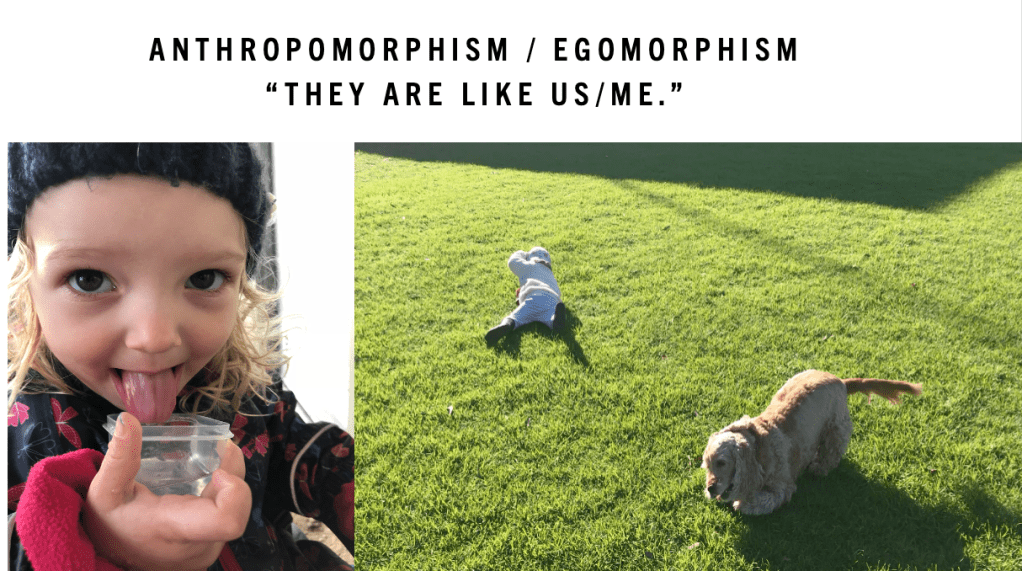
Anthropomorphism attributes general human qualities to nonhumans (“they are like us”), and has often been treated as a methodological flaw. Kay Milton extends this to include egomorphism which is when we projects one’s own embodied experience onto another being (“they are like me”). Pauliina Rautio (2017) argues, anthropomorphic /egomorphic practices could be understood as interspecies articulation: creative, relational, and affective ways of connecting, by supporting resonance, empathy, and embodied extension. She argues what if family were all those who slept in our bed or ate food from the fridge.
Vignette: Poppy drinks water from a bowl. Wren is curious – how does it feel to drink water with her tongue? She takes her cup and drink like she does. For weeks she says no to sipping from a cup, she drinks only from a bowl.
rolling over rolling over encounterings mimicry free
grasses greening stretching scratching bodies
shadowing deepening recognition grasses greening grasses greening not only
entwined joys tangled knowing rolling over rolling over with kin
Mary Oliver in her book of essays in Upstream wrotes: “Deep in the wood I tried walking on all fours. I did it for an hour or so, through thickets across a field, down to a cranberry bog. I don’t think anyone saw me! At the end I was exhausted and sore but I had seen the world from the level of grasses, the first bursting growth of trees, declivities, lumps, slopes, rivulets, gashes, open spaces. I was some slow old fox, wandering breathing, hitching along, lying down finally at the edge of the bog under the swirling rickrack of trees (2019, 19)
Olivers account projects a sensitivity just like Wren, for creating openings where humans glimpse themselves in and as others, while still acknowledging the risks of flattening difference. Egomorphism opens a bridge for extending ourselves into interspecies kinship.
2. Ecomorphism – “We are entangled.”
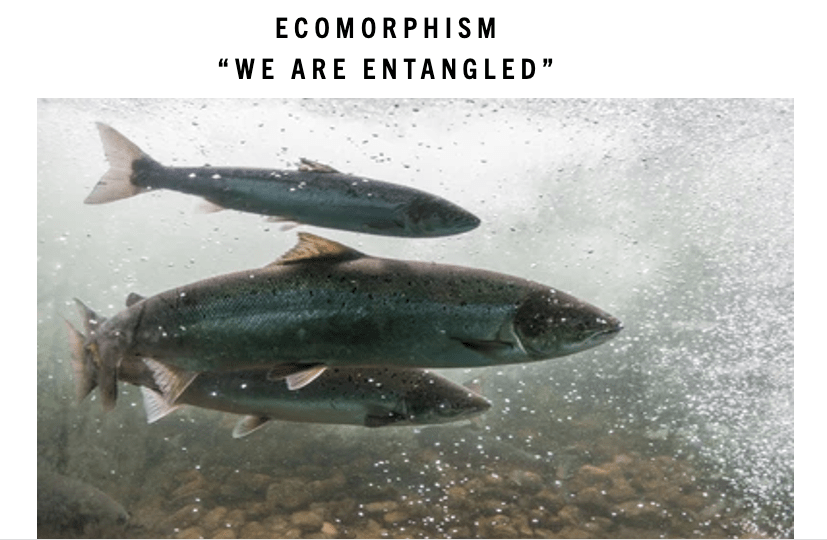
Ecomorphism, as Ashton Nichols (2011) describes, decentres the human. It does not say “they are like us” but instead: “we have always been part of them.” It recognises human and non-human subjectivity as shaped through ecological entanglement.
Vignette (fungi speaking): The rain keeps trickling down and we fungi take the droplets along Mycelial threads connecting plants in a shared communication and nutrient network as we have done for millions of years. Storing away in finite hiding holes through the forest web, becoming drought ready. In the darkness underground we continue shaping the Earth.
Martin Müller offers a parallel entanglement in Being Salmon, Being Human:
“The salmon was not a resource. It was a relation, a kin, a participant in the same story that we are part of. And when we began to listen, to truly listen, with our hearts and bodies and imaginations, the salmon began to teach us how to live.” (2017, p. 226)
The salmon and the fungi reminds us that we are porous beings living in shared worlds, sometimes outside of humans. Writing ecomorphically means giving form to this porosity, crafting stories that decentre the human and foreground ecological interdependence.
3. Animism – “Others live outside of us.”
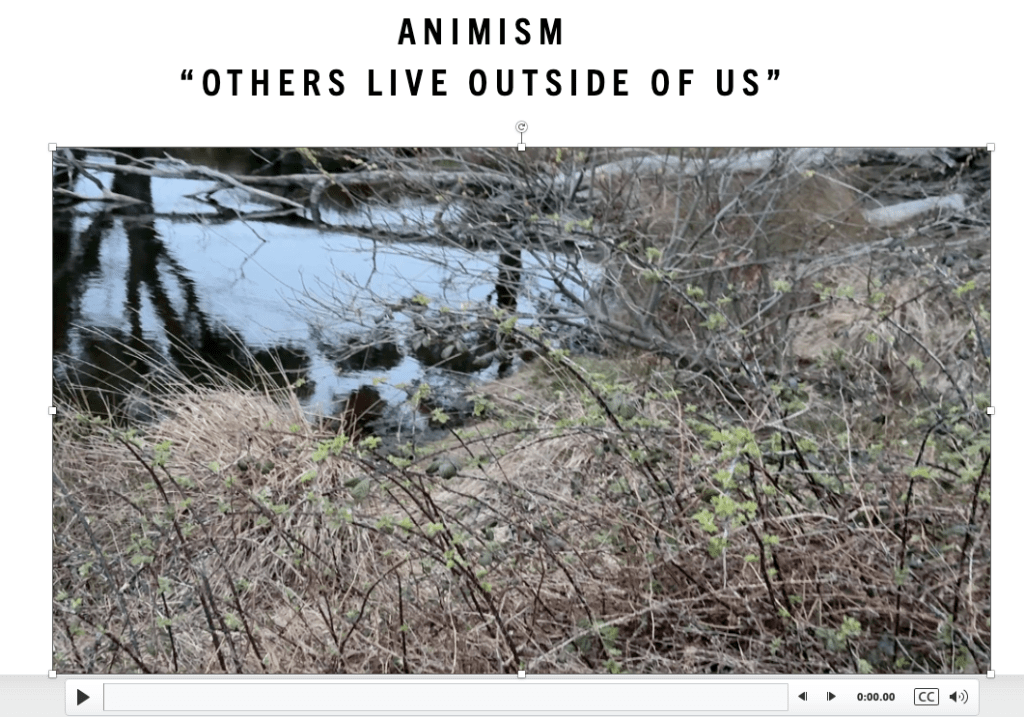
Animism is not a projection but recognition. It affirms that nonhumans rivers, frogs, glaciers, stones, ticks are always already living, agentically both in the absence or presence of humans. There is ancestry, history, aliveness. In Indigenous epistemologies (and past western paganism), animism is not a metaphor but ontology: land is kin, water is law, plant co-teachers.
Vignette (frog speaking through video): Poorneet rains swell the marsh. The call vibrates through reed and mud, joining countless throats in layered resonance. Moist air, rising waters, insect stirrings, all signal abundance. Through repetition, we mark territory, seek companions, and affirm life’s seasonal rhythm. Eggs loosen tadpoles scatter into rippling shallows.
Robin Wall Kimmerer, in her latest book The service berry: an economy of gifts and abundance, frames relations, gratitude and reciprocity as a gift economy:
“In traditional Anishinaabe economy the land is the source of all goods and services, which are distributed in a kind of gift exchange: one life is given for another. Receiving a gift from the land is coupled with attached responsibilities, of sharing, respect reciprocity and gratitude. Your life is nurtured from the body of Mother Earth” (2024, p. 6).
Together, Anthro/egomorphism, ecomorphism, and animism expand the repertoire of critical autoethnography. They allow us to write not only about more-than-human worlds, but with them, through them, and sometimes as them.
Closing Reflections
Critical autoethnography has always been about transformation, of self, of community, of cultural imagination. Speculative interspecies autoethnography extends this to consider each touch is interspecies; each change is contributing to a worlds not yet. So what do these three modes offer you as writer- researcher
Anthropomorphism offers empathy. Used carefully, it is a bridge: a way to say I see myself in you or in the case egomorphism I am being you. Yet we must remain vigilant, for it risks collapsing other beings into human categories, or appropriating what it means to be non-human. It should be a starting point, not an end.
Ecomorphism offers relational humility. It reminds us we are already entangled in interdependent ecosystems, it foregrounds the porousness of subjectivity — with air, with soil, with salmon, with glaciers. It is about writing with these assemblages. Writing ecomorphically means crafting stories of interdependence, refusing and rejecting human exceptionalism. Useful for interdisciplinary futuristic writing as it can bring together and weave disciplines of science, ecology, technology, indigenous and social sciences.
Animism offers recognition. It calls us to honour the aliveness of other beings on their own terms. Their histories and emergences are earth making (not human making). It reminds us that our task is not to give a voice but to listen to diverse modes of speaking, nature speaks already in spores, in rivers, in glacial flows. The intensity of sound as the Glacier coughs and calves large ice blocks into rushing water, she tells us these are the final death throes of her melting, her loss, or deadly silence of a barren land viod of birdsong, the island of Guam where bitds were decimated by climate change, invasive species, US militarisation.
Together, these modes form speculative possibilities. A way of unsettling the sovereign self and writing from entangled worlds where more-than-human others are not silent backdrops but narrative agents and kin. They invite us in as a rehearsal for considering other ways of being. A way of practicing how to live otherwise.
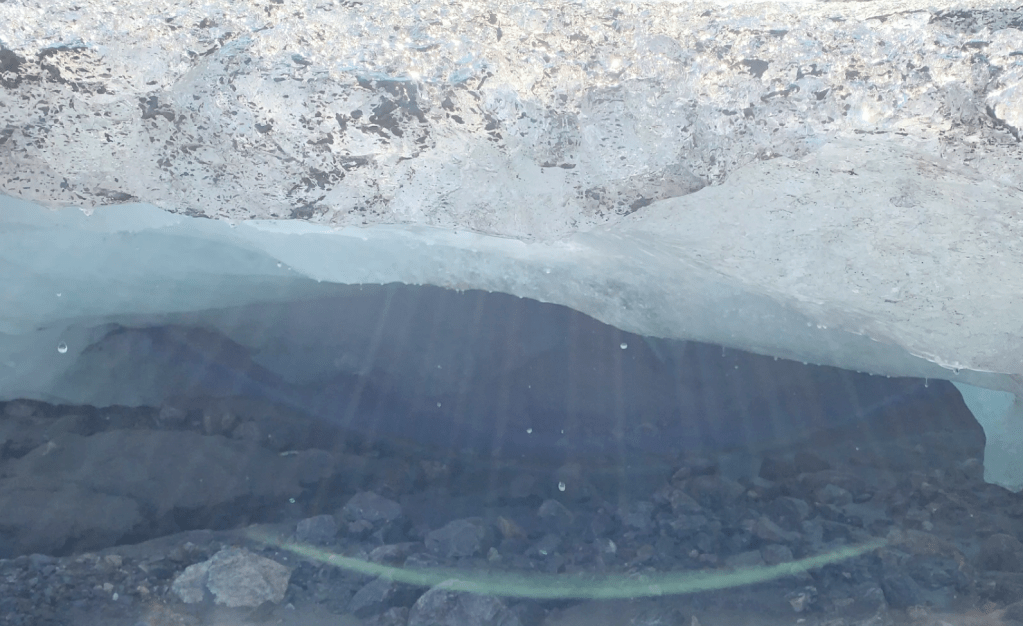
COUGHING
Coughing the mournful cry of my vanishing future.
The raucous coughing of Glacier joins the cacophony of whispering, creaking, dripping, roaring, and trickling water. The roaring of rushing water, heralding a merciless countdown. Standing on the edge, Hardangerjøkulen calls out across the melting ice dome. Rising higher and drawing closer, I anticipated a deathly quiet. A settling. I would crawl up on to her, feel comfort by resting in her motherly belly. But as shared bodies clambered over icy edges the calm and silence were broken by a thundering crash, the rending of a mighty glacier sending forth its limbs. The sounds of her dying throes calling out to the world. The tick, tick, ticking as the hands of a doomsday clock move in time with my hastening heartbeat. She coughs again, vibrations shudder through our bodies and we wait mesmerised. We are held in the slowing, the waiting, the pause, and then the crashing of ice splintering, thundering, deepening her fleshiness. The awkward uncomfortable knowing. She is ruptured, she is in pain. Parts of her are tearing away. She is calving deep, deep in her belly a large slither of ice is now rushing along and joining others in the turbulent underground river flowing beneath our feet. Pieces of her will resurface and rush along, a wild tempestuous body of water we will pass over on our journey home.
Coughing the mournful cry of a dying Glacier.
(Extract from Malone et. al (2024) Chapter 2, page33).
Three Modes for exploring Speculative Interspecies Autoethnography
| Modes | Definition/Use | Voice Agency/ Common uses | Examples through Glacier and Radiation |
| 1.Anthropomorphic Art / Literature / Philosophy human-centered voice | Assigns human-like traits or emotions to non-human entities. Supports storytelling or emotional engagement but can romanticise nature, and support binaries. | Human voice / human emotion Storytelling, myth, creative fiction | Saying “the glacier mourns” or “the radiation is angry” |
| 2. Ecomorphic Ecology / Posthuman/ Science Non-Human/human ecological voice | Focuses on the non-human’s adaptations and roles in the ecosystem. Decentres the human encourages view human as nature. Frames the entity as an ecological/material force shaped by physics & environment | Ecological agency / adaptive response Nature writing, Eco-poetic, nature/ science – writing | A glacier’s melt pattern shaped by seasonal temperature shifts. Radiation dispersing through geological formations. |
| 3. Animism Relational/Animist Indigenous Knowledge / Eco-philosophy Non-human as kin, co-being | Honours non-human as a living, intentional presence. Recognises the non-human as kin, ancestor, or co-being entangled in a lived ongoing relation with human. Co-shaping histories. | Relational, situated, reciprocal Indigenous storytelling, ecopoetics, decolonial and spiritual approaches, sensorial recordings | Glacier as ancestor or elder; river as relative. Radiation as haunting presence entangled with memory, land and precarious futures |
This post is a summary of a presented at the 10th Annual Critical Autoethnography Conference, Fictions, Fantasies and Futures held on 1-3 October, Monash University Docklands, Melbourne
I would like to acknowledge the Wurundjeri people of the Kulin nation. People of the Wurun (Manna gum), the Mother tree that provides shelter and gives life to the Djeri, critters that live within its bark and nourish all kin on Country.
Key References
Barad, K. (2007). Meeting the universe halfway. Duke.
Bennett, J. (2010). Vibrant matter. Duke.
brown, a.m. (2017). Emergent strategy: Shaping Change, Changing Worlds. AK Press.
Butler, O. (1993). Parable of the Sower. Four Walls Eight Windows.
Carson, R. (1965). The sense of wonder. Harper & Row.
Kimmerer, R. W. (2013). Braiding sweetgrass. Milkweed.
Kimmerer, R. W. (2024). The Serviceberry: Abundance and Reciprocity in the Natural World, Scribner Book Company.
Kirby, V. (2011). Quantum Anthropologies: Life at Large. Duke University Press.
Malone, K. (2019), Walking-with children on blasted landscapes, Journal of Public Pedagogies, 4,155-164.
Malone, K. and Moore, S.J., (2019). Sensing Ecologically through Kin and Stones, International Journal of Early Childhood Environmental Education, 7(1), p. 8-25.
Malone, K, and Crinall, S. (2023) Children as Worlding but not Only: holding space for unknowing and undoing, unfolding and ongoing, Children’s Geographies. 21(6), 1186-1200.
Malone, K, Blekinsop, S. Jickling, B, and Morse, M. (2024) Wilding Ecologies: Walking-with Glacier, Palgrave.
Mazzei, L. A., & Jackson, A. Y. (2017). Voice in the agentic assemblage. Educational Philosophy and Theory, 49(11), 1090-1098.
Milton, K. (2005). Anthropomorphism or egomorphism? The perceptions of non-human persons by human ones. In J. Knight (Ed.), Animals in Person, Routledge.
Müller, M. (2017). Being salmon, being human. Chelsea Green.
Nichols, A. (2011). Beyond Romantic Ecocriticism. Palgrave.
Rautio, P. (2017). Being nature: Interspecies articulation. Environmental Education Research, 26(9–10).
Springgay, S. & Truman, S. (2017). Walking Methodologies in a More-than-human World, Routledge.
Uexküll, J. von. (1934/1957). A Stroll Through the Worlds of Animals and Men: A Picture Book of Invisible Worlds. In C. H. Schiller (Ed. & Trans.), Instinctive Behavior: The Development of a Modern Concept (pp. 5–80). New York: International Universities Press.
 Environmental Sustainability Education in the Anthropocene Collective