Author Professor Karen Malone
Introduction
The paper argues for a transformative ecological educational paradigm that could be aligned with supporting an emerging philosophy to support ecological civilizations. It does this by exploring how a reimagining of education through ecological and ethical lenses can support learning with and as the environment, where children are co-constituted learners and teachers supporting a liveable future. It maps a reimagining of education through recent turns in theoretical thinking in deep ecology, ecofeminism, posthumanism, new materialism, and indigenous approaches and by assembling a community of theorists. Then through the stories gathered by me as a posthuman research educator these theories will be put to work. Through this philosophical analysis and cartography, this essay maintains that an ecological approach to education drawing on these theoretical frames can cultivate new relational ontologies, pedagogies and understandings, enhancing ethics, matters of care and respect, resilience, hope and enchantment for a future world.
1. Setting the scene – education for an ecological civilisation
I want to begin with the provocation that our current educational systems were never designed for the Anthropocene.
Michael Paulsen and colleagues, in Pedagogy in the Anthropocene, argue that if humans are now a geological force, then education must fundamentally shift from centring the human, to what they call becoming “more life-centred.” I’m taking up that invitation by asking:
- What might education for an ecological civilisation look and feel like?
- And how might it cultivate resilience, hope and enchantment, rather than only despair?
By ecological civilisation I mean more than “greening” existing systems. I’m thinking of a deeper transformation in how societies understand their obligations to the more-than-human world; a civilisation built on relationality, reciprocity and care, rather than extraction and mastery.
My argument is that such a transformation is impossible if we do not also transform education. We need pedagogies that actively undo human exceptionalism and invite children to learn with and as nature, rather than about nature as an external object.
To do this I assemble a cartography – you can see a version of it on the slide – that draws together five intertwined strands:
- deep ecology
- ecofeminism
- posthumanism
- new materialism
- and Indigenous approaches and knowledges
And then I put those theories to work through stories from my research with children across Kazakhstan, Vietnam, Bolivia and Australia.
2. Deep ecology – intrinsic value and speculative futures
I’ll start with deep ecology. Arne Naess reminds us that all forms of life have intrinsic value, regardless of their usefulness to humans. We are nodes in a vast web, not the apex of a pyramid. Deep ecology asks us to cultivate an ecological self, a sense of identity inseparable from the wider living world.
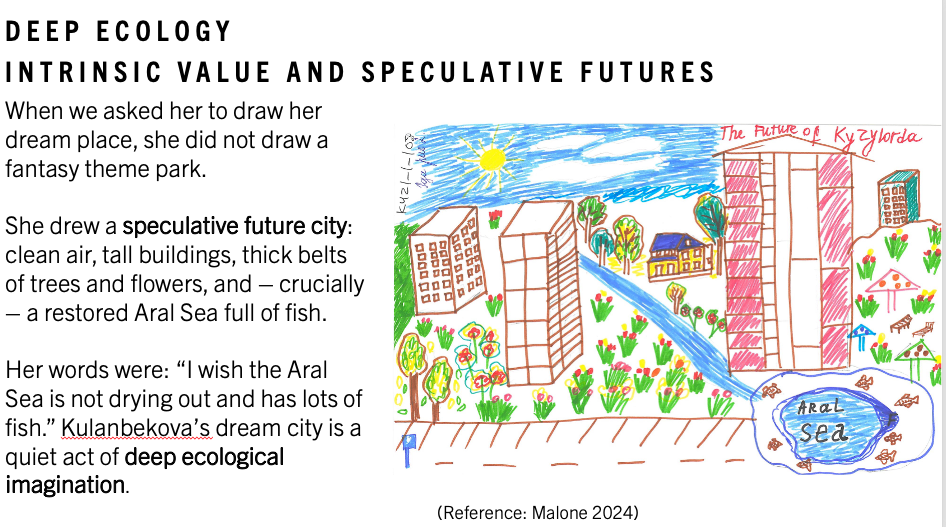
On the slide you can see a drawing by Kulanbekova, a 15-year-old girl from Kyzylorda, Kazakhstan – a city on the dried edges of the Aral Sea. When we asked her to draw her dream place, she did not draw a fantasy theme park. She drew a speculative future city: clean air, tall buildings, thick belts of trees and flowers, and – crucially – a restored Aral Sea full of fish. Her words were: “I wish the Aral Sea is not drying out and has lots of fish.” Kulanbekova’s dream city is a quiet act of deep ecological imagination. From a landscape of dust storms and environmental ruination she refuses resignation. Her drawing enacts Naess’s ecological self – a self that can only flourish if the sea, the fish, the trees and the people flourish together. In deep-ecology-inflected education, then, ethics is not an abstract topic. It is a lived practice of recognising the right of rivers, soils and animals to exist and thrive. Children like Kulanbekova are not only learning environmental “facts”; they are co-creating visions of livable futures.
3. Ecofeminism – matters of care and child–virus relations
The second strand is ecofeminism, which exposes how the same logics that justify domination of nature are used to justify domination of women, children, colonised peoples and other Others. Ecofeminism insists that any ecological civilisation must also be a feminist and decolonial one. During COVID-19, with Chi Linh Tran, I explored how children understood the virus. Instead of treating COVID as a purely biomedical threat, we approached it as a multispecies relation.
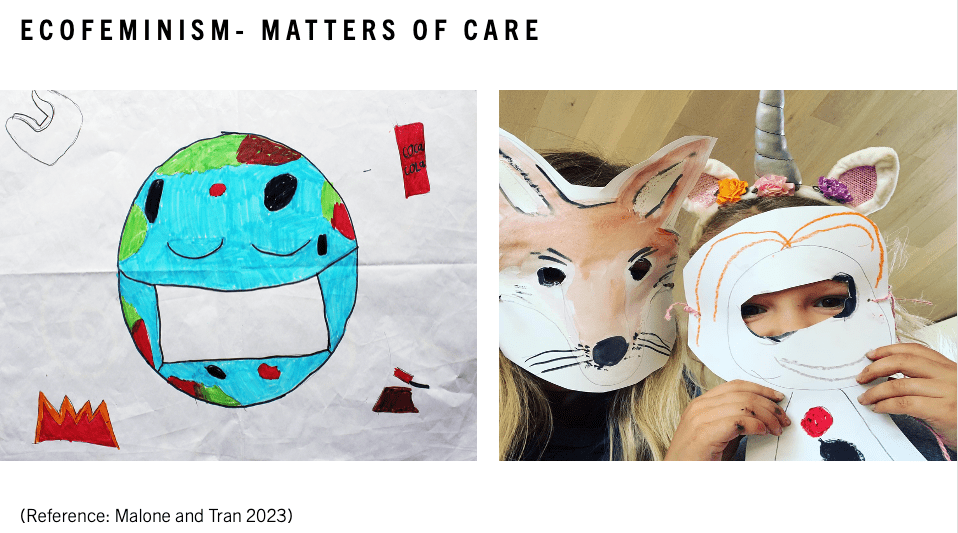
One girl drew a picture of Mother Earth wearing a mask. She told us: “This is our Mother Earth. She is being masked. She is sad. I wish we did not need to be masked and protected together.”
Another moment: my granddaughter Wren asked, “Why do people have to wear masks and animals don’t?” Very quickly we were trying on masks, making animal masks, becoming fox and unicorn together.
These stories reveal what I call an ecofeminist ethics of care and co-vulnerability. Children sense that the virus, the atmosphere, human lungs, animal bodies and planetary health are entangled. Their drawings and questions diffract Plumwood’s call for “mutual flourishing” and Thich Nhat Hanh’s notion of inter-being: there is no isolated human subject standing safely apart.
Ecofeminist pedagogy, then, invites children to stay with the complexities of care: care for each other, for vulnerable bodies, for air quality, for Mother Earth masked alongside us. It interrupts the fantasy of human control and replaces it with shared responsibility.
4. Posthumanism – child–dog encounters and more-than-human agency
From ecofeminism I move to posthumanism and relational ontologies.
Posthumanism, as Rosi Braidotti and Donna Haraway remind us, is not about removing the humans – it is about decentring the human so that the lively agencies of animals, technologies, atmospheres and objects can come into view. In La Paz, Bolivia, I walked with children through steep neighbourhoods crowded with street dogs. Diego, aged 12, took photographs of dogs on rooftops, in alleyways, at eye level with children.
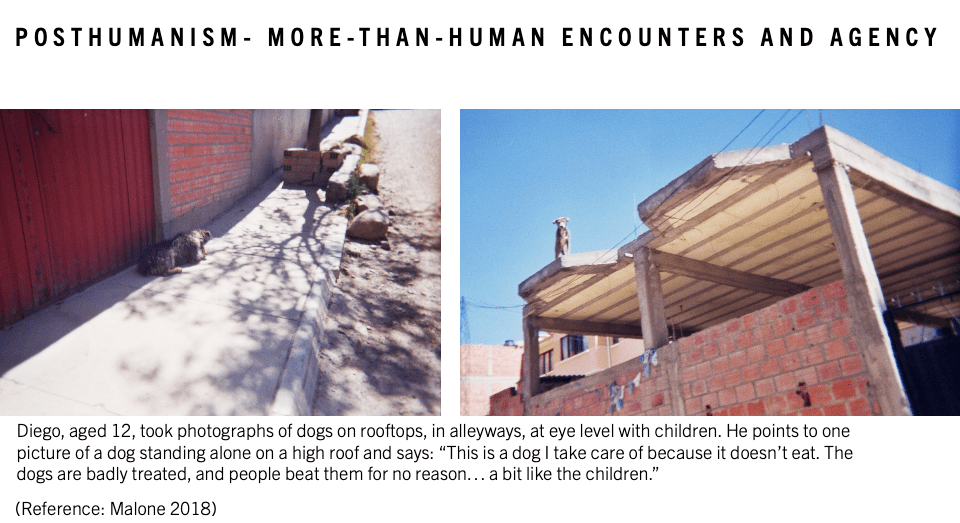
He points to one picture of a dog standing alone on a high roof and says:
“This is a dog I take care of because it doesn’t eat. The dogs are badly treated, and people beat them for no reason… a bit like the children.”
In another photograph he shows a dog that “sometimes gets beaten”, explaining that the streets are dangerous for both children and dogs, and that sometimes they hide together on the rooftops.
These images and words are not simply about “pets” or “urban wildlife”.
These images reveal a posthuman ecological community where child and dog share vulnerability, agency and survival tactics. They co-create what I’ve called multispecies conatus – borrowing from Spinoza’s idea that every being strives to persevere in its own way. A posthuman educational practice does not treat animals as mere teaching resources. Instead, it recognises dogs, viruses, mountains and plants as co-teachers and co-participants in children’s ethical formation.
5. New materialism – barkskin, planty childhoods and lively matter
The fourth strand is new materialism, which asks us to take matter seriously as active and agential. Think of Jane Bennett’s “vibrant matter” or Margaret Cavendish’s seventeenth-century claim that even so-called inanimate objects are self-moving and lively.
In research with colleagues Sneha Parmar and Tracy Young at the Royal Botanic Gardens in Melbourne, we explored what we now call “planty childhoods.” Children spent time in a bamboo grove, feeling and rubbing the bark, pressing it onto paper, comparing textures.
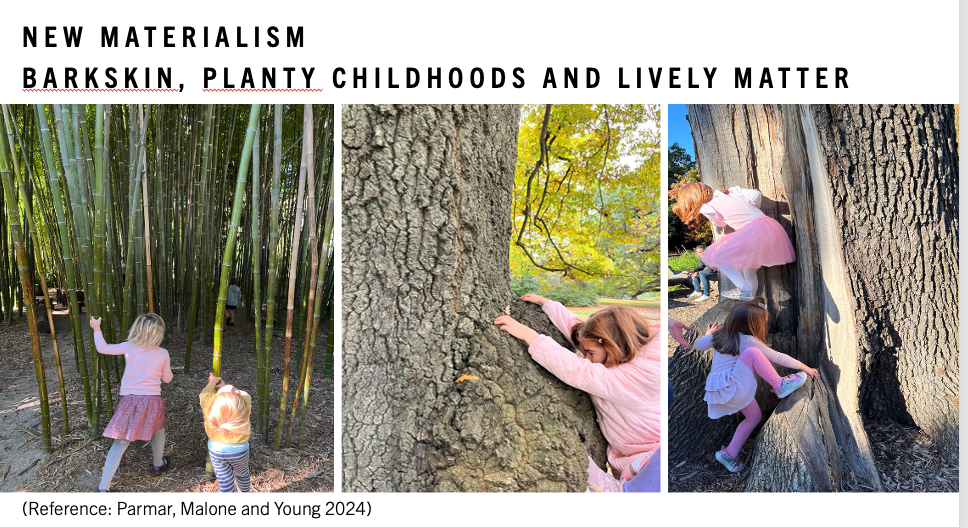
One child noticed that paperbark peels away “like paper”, another that rough bark feels like armour. In our storytelling the tree interrupts and burst forth into our thinking :
“Hey you kids, that hurts. My bark is like the skin that covers your body.”
We began to speak and share the notion of barkskin, a concept that blurs the line between tree bark and human skin, between protection for trees and protection for people. Skin as a covering a porous blurred boundary between and defining objects and entities.
Here, bark is not just an example of “tree adaptation” in a science lesson. It becomes a material companion that shapes children’s thinking, sensation and ethics. Children learn by dwelling with bark, sticks, leaves and soil, rather than anthropomorphic we might say this shift is egomorphic we share being an entity defined by the boundaries of our bark/skin.
New materialist pedagogy asks: what happens when we treat materials as collaborators, as knowledge holders and makers? How might classrooms change if plants, stones, mud and waste are acknowledged as participants in learning, with their own temporalities and vulnerabilities? Can we learn to listen to their stories as shared with ours?
6. Indigenous approaches – Dadirri and listening to Country
The fifth theoretical strand is Indigenous approaches and knowledge systems, which are not simply another “perspective” to be added into curricula, but onto-epistemologies that can radically re-orient education.
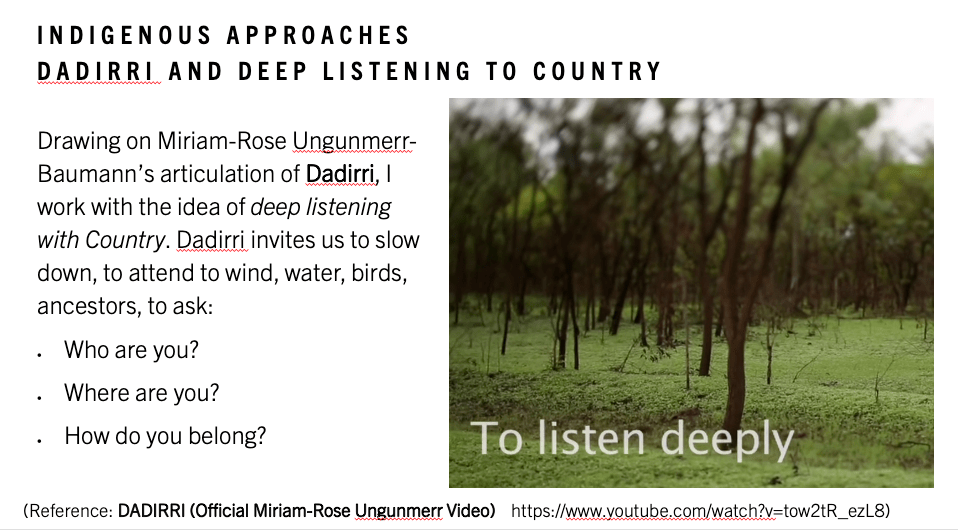
Drawing on Miriam-Rose Ungunmerr-Baumann’s articulation of Dadirri, I work with the idea of deep listening with Country. Dadirri invites us to slow down, to attend to wind, water, birds, ancestors, to ask:
- Who are you?
- Where are you?
- How do you belong?
This resonates with Robin Wall Kimmerer’s idea of the land as teacher and with Indigenous children’s speculative imaginaries of future places that “embrace the precariousness of their landscapes” yet remain committed to care.
When we foreground Indigenous philosophies, ecological education becomes less about managing natural resources and more about entering into reciprocal relations with Country – giving thanks, asking permission, noticing when we are out of balance.
For non-Indigenous educators and children, this also means learning to sit with the discomfort of settler-colonial histories, to recognise that land is never just land; it is law, kin, story, responsibility
6. Enchantment, awe and wonder – feeling-with a lively world
All of these strands come together in the affective register of enchantment, awe and wonder.
Rachel Carson insisted it is critical nurtures a child’s inborn sense of wonder and Dacher Keltner describes awe as the feeling that makes us “small in a good way” – attuned to something larger than ourselves.
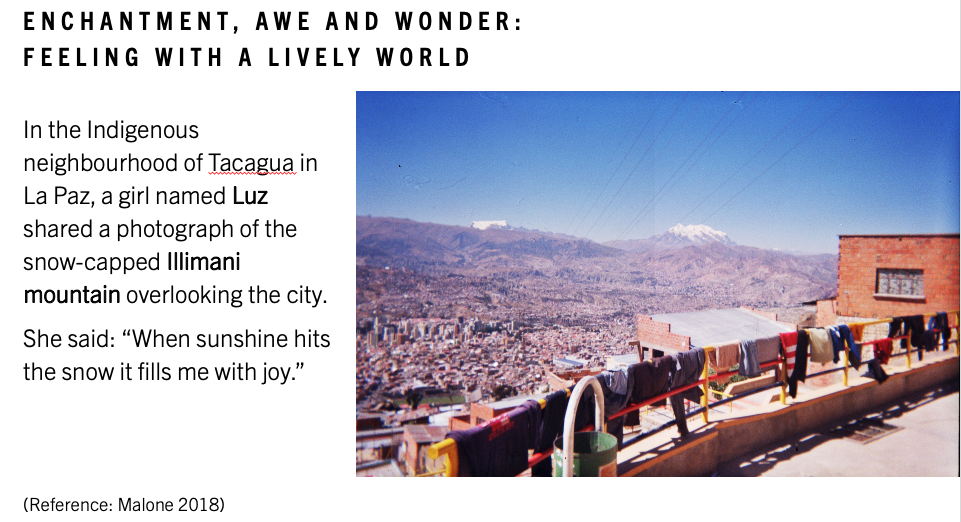
In the Indigenous neighbourhood of Tacagua in La Paz, a girl named Luz shared a photograph of the snow-capped Illimani mountain overlooking the city. She said: “When sunshine hits the snow it fills me with joy.”
Yet scientists as tell us those glaciers in temperate regions have lost most of their mass. Illimani is both a source of joy and a site of climate grief.
To walk-with children in these landscapes is to walk with joy and mourning together. Enchantment is not naïve; it is fully aware of ruination and still capable of love. Jane Bennett has argued that enchantment might be exactly what we need to counter political paralysis a worldly disenchantment feeding a turning away – attachment and love are central to being in deep relation with the Earth – even if it is painful to lose the things we love.
In my work on “childhoodnature,” I propose that child–outdoor–nature encounters are sympoietic – co-created – events that can cultivate precisely this attachment. Awe, and wonder enchantment than are not a luxury; it is a political and ethical resource for fostering ecological resilience.
8. Emerging trends – relational ontologies and messy worlds
Across environmental education there is now a growing body of work – including special issues I’ve been involved in – support a convergence of theoretical strands embodying relational ontologies and multispecies worlds as a starting point. Rather than treating nature as a scenic backdrop for human development, these approaches ask: what if all education is already more-than-human?
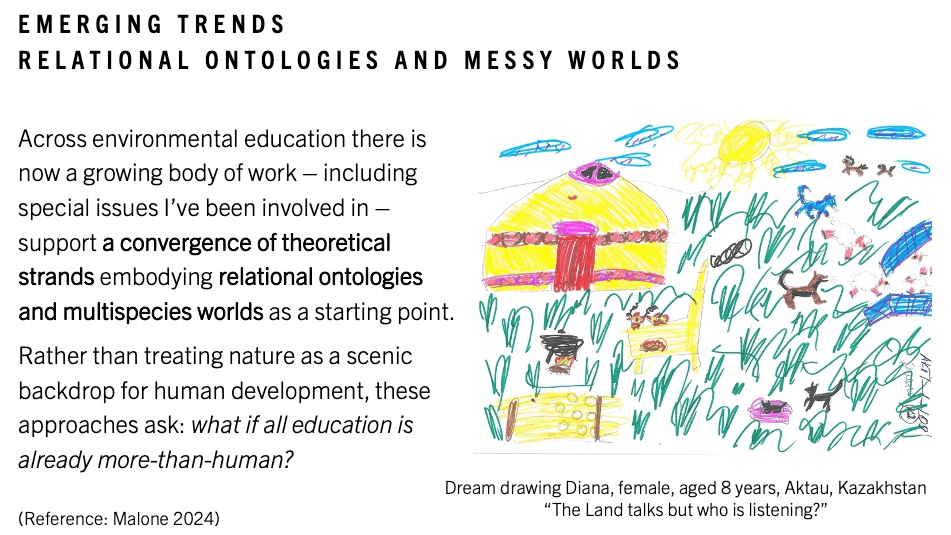
Examples include:
- Nxumalo and Rubin’s decolonial work on children encountering waste-laden frog ponds, where caring for tadpoles cannot be separated from confronting plastics, toxins and colonial infrastructures.
- Studies unsettling human-centred ecological inquiry, such as “ratty places” in Oulu where rats, microbes, children and city politics all become part of the curriculum.
- Ecofeminist and Indigenous-led projects that focus on relational ethics: caring with rivers, listening to the land, learning from bears or kangaroos in damaged ecosystems.
These emerging practices collectively push us toward what I’m calling a transformative ecological education – one that is thoroughly entangled, materially grounded and ethically charged.
9. What might a transformative ecological education look like?
So what might this mean for concrete pedagogical practice? From the cartography I’ve sketched, a few key characteristics emerge:
- Learning with and as the environment
- Children are invited into direct, ongoing relationships with local places – rivers, paddocks, gardens, city streets, waste sites – as co-learners.
- Curriculum is grown from these encounters, rather than imposed as abstract content.
- More-than-human co-teachers
- Dogs, plants, weather, rocks, glaciers, viruses, even waste become recognised as active participants in learning.
- Teachers cultivate attentiveness to how non-human agencies shape the lesson.
- Ethics of care, reciprocity and deep listening
- Ecofeminist and Indigenous ethics foreground care not as a soft add-on but as a rigorous practice of attending to vulnerabilities and interdependencies.
- Practices such as Dadirri invite teachers and children into quiet, contemplative modes alongside activism.
- Cultivating enchantment alongside grief
- Experiences of awe, joy and curiosity are intentionally nurtured – watching clouds, feeling barkskin, listening to glaciers “cough”.
- At the same time, children are not protected from knowledge of loss; instead we support them to hold grief and hope together as active hope.
- Relational ontologies as everyday practice
- We shift from asking “How do we teach children about nature?” to “How are children already entangled with nature, and how can education make those relations more ethical, just and joyful?”
10. Closing – resilience, hope and enchantment for a future world
I want to close by returning to the bigger question of educations role in a future ecologicalising civilisation. Capitalism, individualism and humanism – the fantasy of human mastery founded on 16th century anthropocentricism still underwrite much educational policy and practice. Yet, as I’ve tried to show, there is already a vibrant counter-current of theories and pedagogies – deep ecology, ecofeminism, posthumanism, new materialism, Indigenous wisdoms – that are re-imagining education from the ground up.
Across the stories I’ve shared, children are:
- dreaming restored seas,
- masking Mother Earth alongside themselves,
- hiding on rooftops with street dogs,
- wondering whether bark is really a kind of skin,
- feeling joy when sunlight touches a melting glacier,
- listening with Country through Dadirri.
These are not just cute anecdotes. They are ethical experiments in becoming-with the world.
My claim is that transformative ecological education is not primarily about delivering more environmental information. It is about cultivating new relational habits – habits of attention, attachment, care, deep listening, and enchanted wonder – that can sustain both human and more-than-human resilience in precarious times.
If we take children seriously as co-constituted learners and teachers, then they are already helping us to map the contours of an ecological civilisation. Our task as educators, researchers and policymakers is to walk-with them, to nurture these fragile cartographies of hope and enchantment, and to fight for educational structures that allow such practices to flourish.
This paper was presented at the Philosophy of Education Society of Australasia (PESA) in December 2025. The paper is drawn from a recent chapter published in the Handbook for Ecological Civilisations entitled “Children’s Imaginaries of Ecological Civilizations: Mapping Theories and Ethics for a Transformative Ecological Education” (https://link.springer.com/rwe/10.1007/978-981-97-8101-0_69-1)
Informing References
Bennett J (2001) The enchantment of modern life: attachments, crossings, and ethics. Princeton University Press, Princeton
Keltner D (2023) Awe: the new science of everyday wonder and how it can transform your life. Penguin Press, New York
Malone, K. (2018) Children in The Anthropocene, Palgrave.
Malone K (2024) Indigenous children’s speculative future imaginaries of place, weathering and ruination. In: Bishop K, Dimoulias K (eds) The Routledge Handbook of the Built Environments of Diverse Childhoods, Routledge. https://doi.org/10.4324/9781003284406-15a
Malone, K. (2025) Children’s Imaginaries of Ecological Civilizations: Mapping Theories and Ethics for a Transformative Ecological Education in M. A. Peters et al. (eds.), Handbook of Ecological Civilization, Springer International Handbooks of Education, https://doi.org/10.1007/978-981-97-8101-0_69-1
Malone. K. and Tran, C. (2023) Diffracting Child-Virus Multispecies Bodies: a Rethinking of Sustainability Education with East – West Philosophies, Educational Philosophy and Theory Journal, 55 (11), 1296-1310
Parmar S, Malone K, Young T (2024) Planty childhoods: theorising with a vegetal ontology in environmental education research. Australian Journal of Environmental Education 40(2):243–257. https://doi.org/10.1017/ aee.2024.29
Paulsen M, Jagodzinski J, Hawke S (2022) Pedagogy in the Anthropocene: re-wilding education for a new earth. Palgrave, Basingstok
Ungunmerr MR (1988) Dadirri. Miriam Rose Foundation. https://www.miriamrosefoundation.org. au/dadirri/
 Environmental Sustainability Education in the Anthropocene Collective